This page exists because we mean it, not because someone told us to put it here. We write about Andar Bahar, Teen Patti, and online casinos. We help people find games, understand rules, and pick decent platforms. But none of that matters if the person reading it is gambling with money they cannot afford to lose, or playing to escape a problem instead of for entertainment.
Gambling is fun when it stays in its lane. The moment it starts affecting your sleep, your relationships, your bank account, or your mood on days you are not playing — it has left its lane.
This page is for anyone who wants to check in with themselves honestly. And for anyone who already knows something is off and needs a direction to go.
The line between fun and problem
There is no dramatic moment where gambling goes from fine to not fine. It happens gradually. A few extra rounds here. A slightly bigger bet there. One more deposit “just this once.” Staying up later than planned because you are trying to win back what you lost.
Most people who develop a gambling problem did not plan to. They started out playing for fun — and many of them were winning at first. The trouble began when playing stopped being optional and started feeling necessary.
Here are some honest questions to ask yourself.
Self-assessment — ten questions
Read through these slowly. Be honest. Nobody is watching.
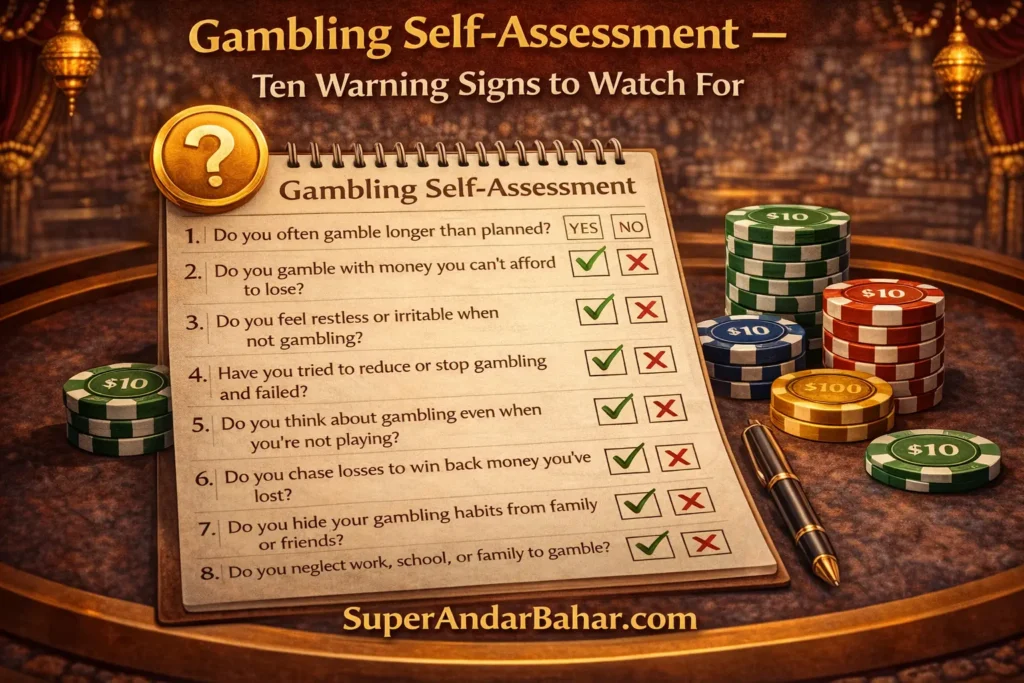
- Have you ever gambled with money that was meant for bills, rent, or daily expenses?
- When you lose, do you feel a strong urge to keep playing until you win it back?
- Have you lied to family or friends about how much you gamble or how much you have lost?
- Do you think about gambling when you are doing other things — at work, eating dinner, trying to sleep?
- Have you tried to cut back on gambling and found it harder than expected?
- Do you feel restless, irritable, or anxious on days when you are not gambling?
- Have you borrowed money or sold something to fund your gambling?
- Has gambling caused arguments or tension with people close to you?
- Do you gamble to escape stress, boredom, loneliness, or sadness?
- After a gambling session, do you often feel guilty, regretful, or empty?
If you answered yes to even two or three of these, it is worth paying attention. That does not mean you have a severe problem — it means the pattern is moving in a direction that deserves a closer look.
If you answered yes to five or more, please talk to someone. A friend, a family member, or one of the organisations listed at the bottom of this page. You do not have to have lost everything for your situation to be worth addressing.
Practical tips for staying in control
You do not need a gambling problem to benefit from these habits. They are just good practice for anyone who plays card games or casino games regularly.
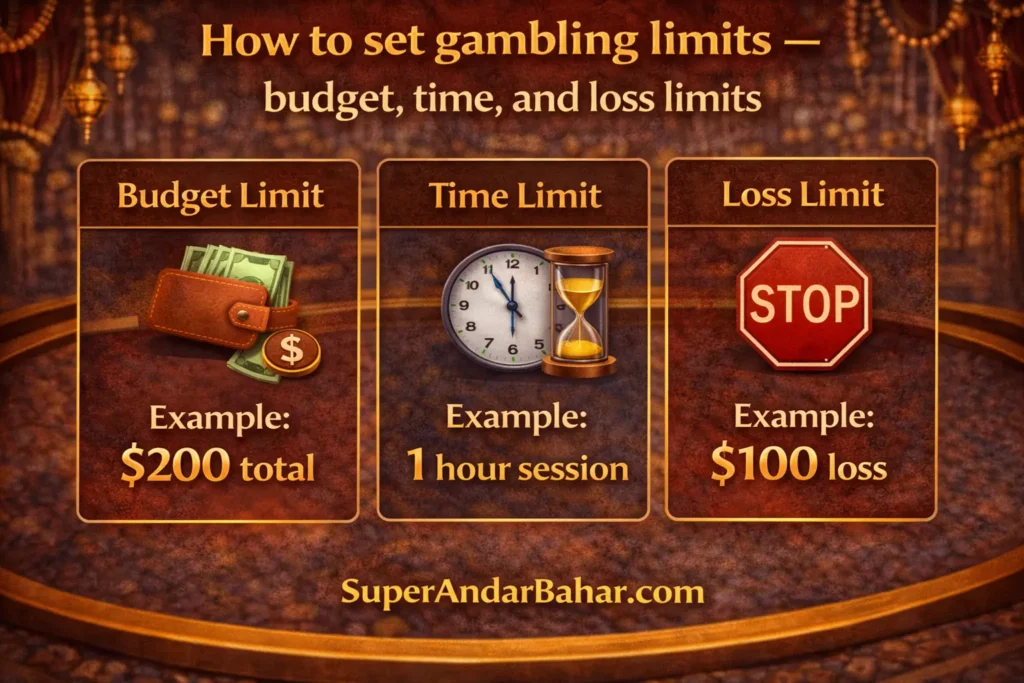
Set money limits before you play
Decide how much you can afford to spend on gambling this week or this month. Not how much you want to spend — how much you can genuinely lose without it affecting anything else in your life.
Once you have that number, divide it into session budgets. If your monthly entertainment budget for gambling is ₹5,000 and you play four times a month, each session gets ₹1,250.
When the session budget is gone, you stop. Not “after one more round.” Not “let me just deposit another ₹500.” You close the app and do something else.
Write them down before every session.
Set time limits
Andar Bahar rounds take less than a minute. Teen Patti is not much slower. It is remarkably easy to play for two hours and feel like it has been twenty minutes.
Before you start, set a timer on your phone. Thirty minutes, forty-five minutes, an hour — whatever feels reasonable. When the timer goes off, stop and assess. Are you still having fun? Are you within budget? Do you actually want to keep playing, or are you just continuing out of habit?
If the honest answer to that last question is “habit” — close the app.
Never chase losses
This deserves its own section because it is the single most destructive behaviour in gambling.
You lose ₹1,000. Your brain says: “If I bet ₹500 on the next two rounds and win both, I am back to where I started.” So you bet bigger. You lose again. Now you are down ₹2,000 and the voice is louder: “Just one big bet to recover.”
This cycle has emptied more wallets than any house edge ever will.
The truth is cold but helpful: the money you lost is gone. The next round does not know or care about the previous one. Betting bigger to recover losses just means you lose bigger.
When you catch yourself thinking “I need to win this back” — that is your signal to stop. Not to bet more. To stop.
Keep gambling separate from emotions
Bad day at work? Fight with your partner? Feeling lonely or bored? These are all real, valid feelings — and they are all terrible reasons to open a casino app.
Gambling when you are emotionally low is risky because you are not playing for entertainment anymore. You are playing for relief. And relief from gambling is temporary, unreliable, and usually followed by a worse mood than you started with.
Find other things that help when you are down. A walk, a phone call, a meal, a show, exercise — anything that does not involve staking money on an outcome you cannot control.
Talk about it openly
Gambling problems thrive in secrecy. The moment you start hiding bets, lying about losses, or clearing your browser history so nobody sees casino sites — the problem is growing.
If you feel the need to hide your gambling from people in your life, ask yourself why. If the answer is “because they would be worried” — they are probably right to be.
Telling one trusted person what is going on can feel terrifying. It can also be the single most important step you take.
Tools casinos offer (use them)
Most licensed online casinos provide built-in tools for responsible gambling. Not everyone knows about them, and even fewer people use them. Here are the ones that actually help.
Deposit limits. Set a daily, weekly, or monthly cap on how much money you can add to your account. Once you hit the limit, you cannot deposit more until the next period. Set this when you create your account — not after a bad session.
Loss limits. Similar to deposit limits, but tracks net losses. When you reach your threshold, the system stops you from playing.
Session time reminders. Some casinos will show a pop-up after 30 or 60 minutes of play, reminding you how long you have been active. It sounds small, but it breaks the trance.
Reality checks. Periodic notifications showing your net win/loss during the current session. Seeing “you are down ₹1,200 in the last 45 minutes” in plain text can snap you out of autopilot.
Cool-off periods. Temporarily block yourself from your account for 24 hours, 48 hours, or a week. Useful if you feel yourself slipping but are not ready for a full self-exclusion.
Self-exclusion. The strongest tool. Block yourself from the casino for months or permanently. Once activated, you cannot reverse it for the chosen period. Use this if you need a hard boundary.
These tools work best when you set them proactively — during a calm moment, not during a losing streak at 2 AM. Configure them when you first register and leave them in place.
If gambling has already become a problem
You do not have to figure this out alone.
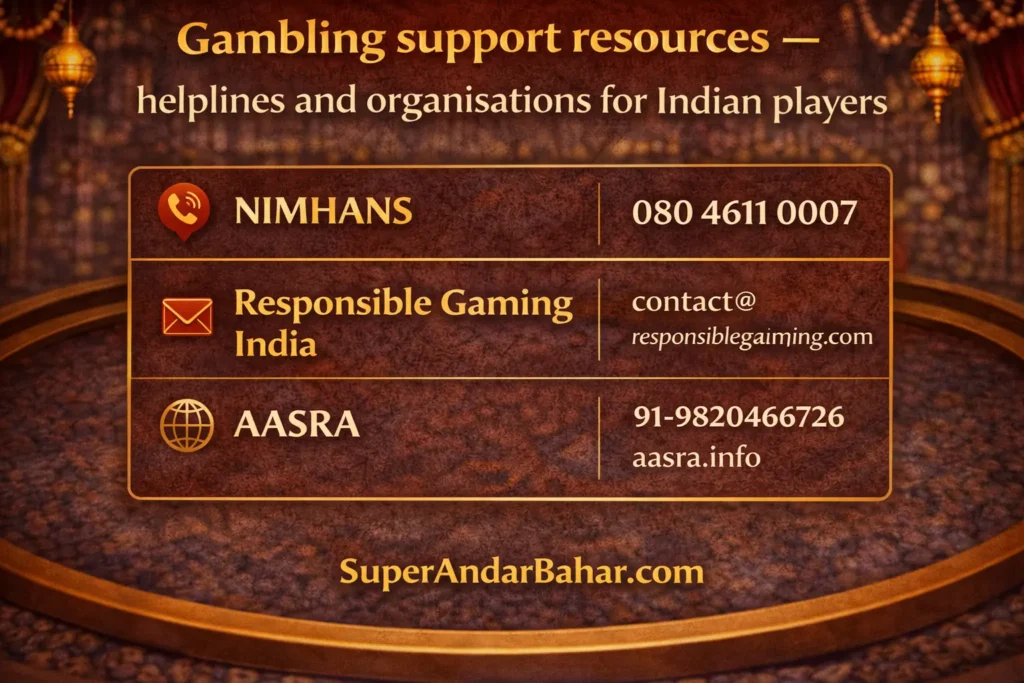
If you are in a place where gambling is hurting your finances, your relationships, or your mental health, here are organisations that can help. Most of them are free and confidential.
International resources:
- Gamblers Anonymous — peer support meetings, online and in-person, available in many countries. www.gamblersanonymous.org
- GamCare — support, counselling, and a helpline for anyone affected by gambling. Available 24/7. www.gamcare.org.uk | Helpline: 0808 8020 133
- Gambling Therapy — free online support from trained advisors, available globally. Live chat, forums, and self-help tools. www.gamblingtherapy.org
- BeGambleAware — information, advice, and support for gambling-related harm. www.begambleaware.org
India-specific resources:
- iCall (TISS Mumbai) — a psychosocial helpline that can assist with gambling-related issues among other concerns. Phone: 9152987821
- Vandrevala Foundation — mental health support available 24/7 in multiple Indian languages. Phone: 1860 2662 345
- National Commission for Women helpline — if gambling is impacting family or household situations. Phone: 7827-170-170
These services exist for people at every stage — from “I think something might be off” to “I am in crisis.” There is no minimum threshold of damage before you are allowed to ask for help. If it is bothering you, it is enough.
For family and friends
If someone you care about is gambling more than they should, you might feel helpless. A few things that can actually help:
Express concern without attacking. “I have noticed you seem stressed about money lately” works better than “You are throwing your money away on gambling.” The first opens a door. The second slams it shut.
Do not cover their debts. Paying off a gambler’s losses feels kind but usually enables more gambling. They need to face the consequences — with your emotional support, not your wallet.
Suggest professional help gently. You cannot force someone to get help. But you can say “I found this number, maybe give them a call?” and leave it there without pressure.
Take care of yourself. Living with someone who has a gambling problem is stressful. You are allowed to seek support for yourself too. GamCare and Gambling Therapy both offer help for family members, not just the person gambling.
Our commitment
SuperAndarBahar.com is a guide to card games, not a casino. We do not take bets, process deposits, or profit from your losses.
When we review casinos, we check whether they offer responsible gambling tools. A platform without deposit limits, self-exclusion, or reality checks does not make our recommendation list — no matter how generous their bonuses look.
Every strategy and game page on this site includes a responsible gambling reminder. We believe that if we are going to help people find places to play, we have an obligation to also help them play safely.
If you think any content on this site encourages irresponsible behaviour, tell us. We take that seriously.
Frequently asked questions
How do I know if I have a gambling problem?
If gambling is causing financial stress, relationship issues, sleep problems, or if you regularly spend more than you planned — those are signs worth paying attention to. Go through the ten questions in the self-assessment above. If several resonate, talk to someone.
Can I set limits at online casinos?
Yes. Most licensed casinos offer deposit limits, loss limits, session reminders, and self-exclusion tools. Look in your account settings or contact customer support. Set these limits when you first sign up, not after things go wrong.
Is it possible to recover from a gambling problem?
Absolutely. Thousands of people recover from problem gambling every year. It usually involves a combination of professional support, honest conversations with people you trust, and practical tools like self-exclusion and financial management. It is not easy, but it is very possible.
I think a friend has a gambling problem. What should I do?
Approach them without judgment. Express concern about what you have noticed — not accusations about their behaviour. Offer to help them find professional support. And take care of your own wellbeing too.
Where can I get immediate help?
Gambling Therapy offers live chat support at www.gamblingtherapy.org. GamCare’s helpline is available 24/7 at 0808 8020 133. In India, the Vandrevala Foundation helpline is 1860 2662 345.
SuperAndarBahar.com is committed to responsible gambling. If you or someone you know needs help, the resources above are free and confidential.
 English
  हिन्दी
  বাংলা
বাংলা  ਪੰਜਾਬੀ
  తెలుగు
  தமிழ்
தமிழ்  اردو
اردو  नेपाली